Oxygen therapy and tissue regeneration
Why oxygen inhalation matters in tissue healing
Oxygen, ATP and cellular survival
Oxygen is fundamental to energy production in the human body. Most oxygen in the blood is transported bound to haemoglobin, while a smaller proportion is dissolved directly in the blood. Without sufficient oxygen, mitochondria cannot produce enough ATP—the energy required for cellular function—eventually resulting in cell death. The consequences of oxygen deprivation are most clearly demonstrated in myocardial infarction and stroke, where a zone of necrosis develops, surrounded by an ischaemic zone in which some cells remain viable, followed by normal tissue in areas receiving sufficient oxygen.
Well-perfused tissues, such as muscles, receive oxygen primarily through its release from haemoglobin. According to the Bohr principle, haemoglobin releases oxygen more readily in an acidic environment. However, dissolved oxygen becomes particularly important in areas with impaired circulation, such as injured tissue, and in tissues without blood vessels that directly supply them, including tendons and cartilage.
Oxygen delivery to tendons and cartilage
Tendons are poorly vascularised, so oxygen reaches them mainly through small surrounding vessels and diffusion from nearby tissues.
Cartilage is essentially avascular, meaning that it has no blood vessels of its own and therefore depends entirely on diffusion from the synovial fluid and underlying bone.
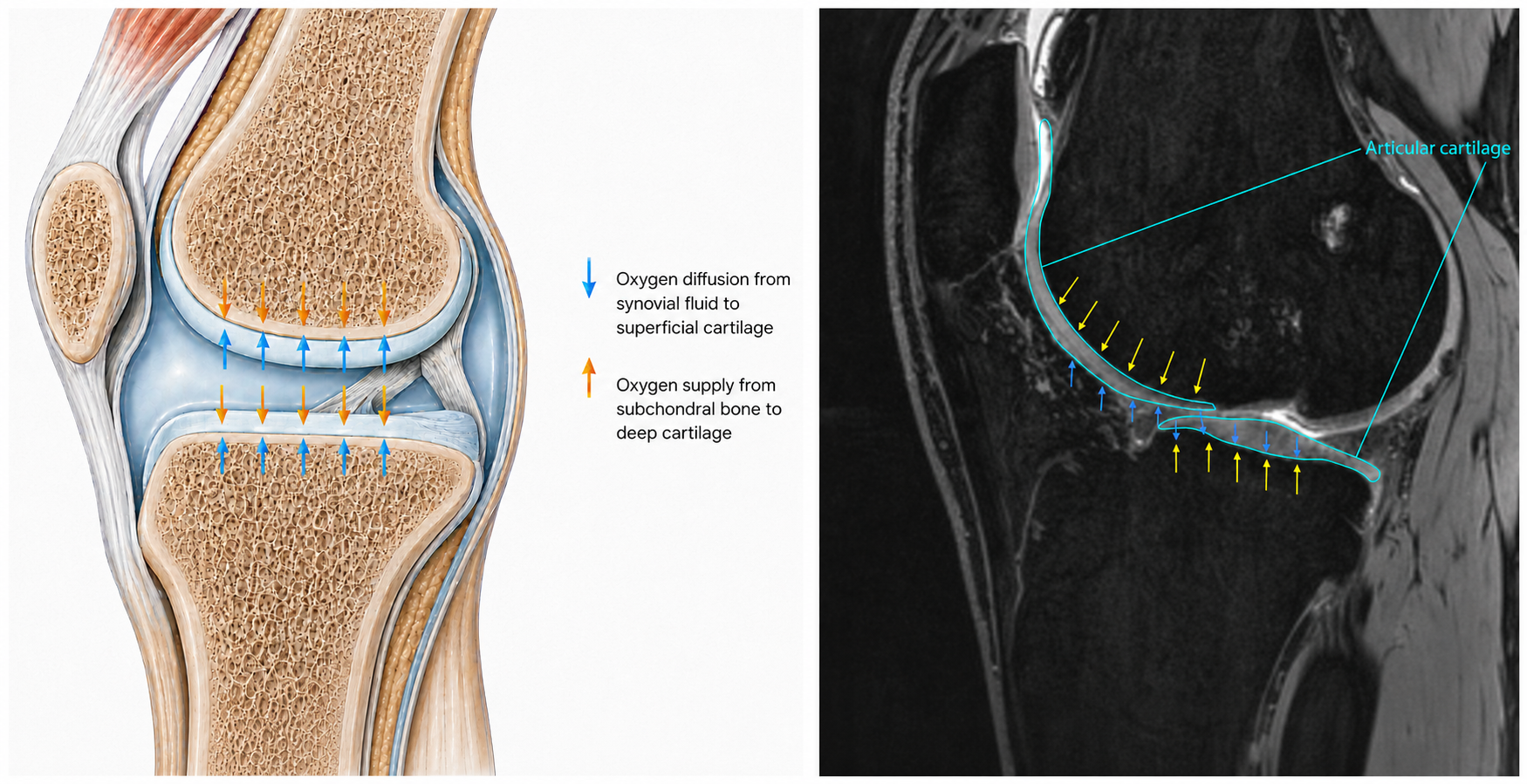
Because oxygen delivery is limited, both tendons and cartilage have a low metabolic rate and a reduced capacity for healing. This is why injuries affecting these tissues generally recover more slowly than muscle injuries. Without sufficient oxygen, tissue regeneration is reduced, while tissue degradation and necrosis increase, contributing to the development and progression of injury. Increasing dissolved oxygen directly increases oxygen availability and supports tissue regeneration.
Hypoxia, tendon degeneration and collagen quality
This process can be observed particularly clearly in a thickened and degeneratively altered patellar tendon. As the tendon becomes thicker and its internal structure deteriorates, the delivery of oxygen and nutrients to its central portions becomes increasingly impaired. The resulting hypoxia activates HIF-1α and VEGF, stimulating the formation of new blood vessels. Although angiogenesis is important during the initial phase of healing, persistent and disorganised neovascularisation is associated with ongoing inflammation, pain and further degradation of the tendon structure.
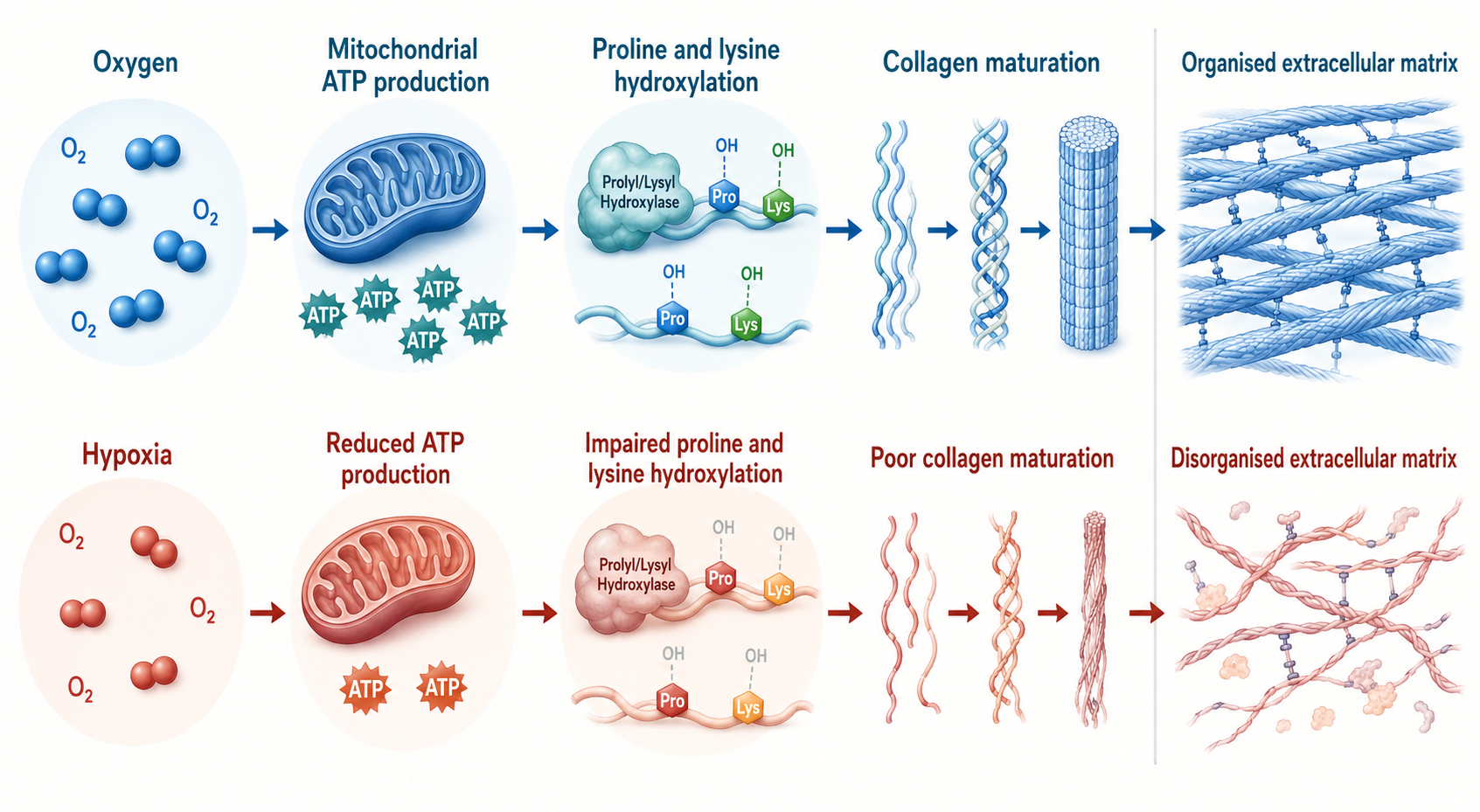
Oxygen is not important only for cellular energy production. It is also essential for collagen synthesis and maturation, particularly for the hydroxylation of proline and lysine, stabilisation of the collagen structure and formation of a functionally resistant extracellular matrix. Inadequate oxygenation can therefore simultaneously limit the energy required for regeneration and impair the quality of newly formed connective tissue.
Key mechanism: oxygen inhalation
Oxygen inhalation: increasing dissolved oxygen availability
Under normal physiological conditions, when breathing air at atmospheric pressure, the amount of oxygen dissolved in the blood is very small, representing approximately 3–4% of the oxygen available to the tissues when calculated using a venous (PvO2) of 40 mmHg. Inhalation of 100% oxygen increases this dissolved oxygen level approximately four- to fivefold, raising the proportion of directly dissolved oxygen available to the tissues to approximately 20%.
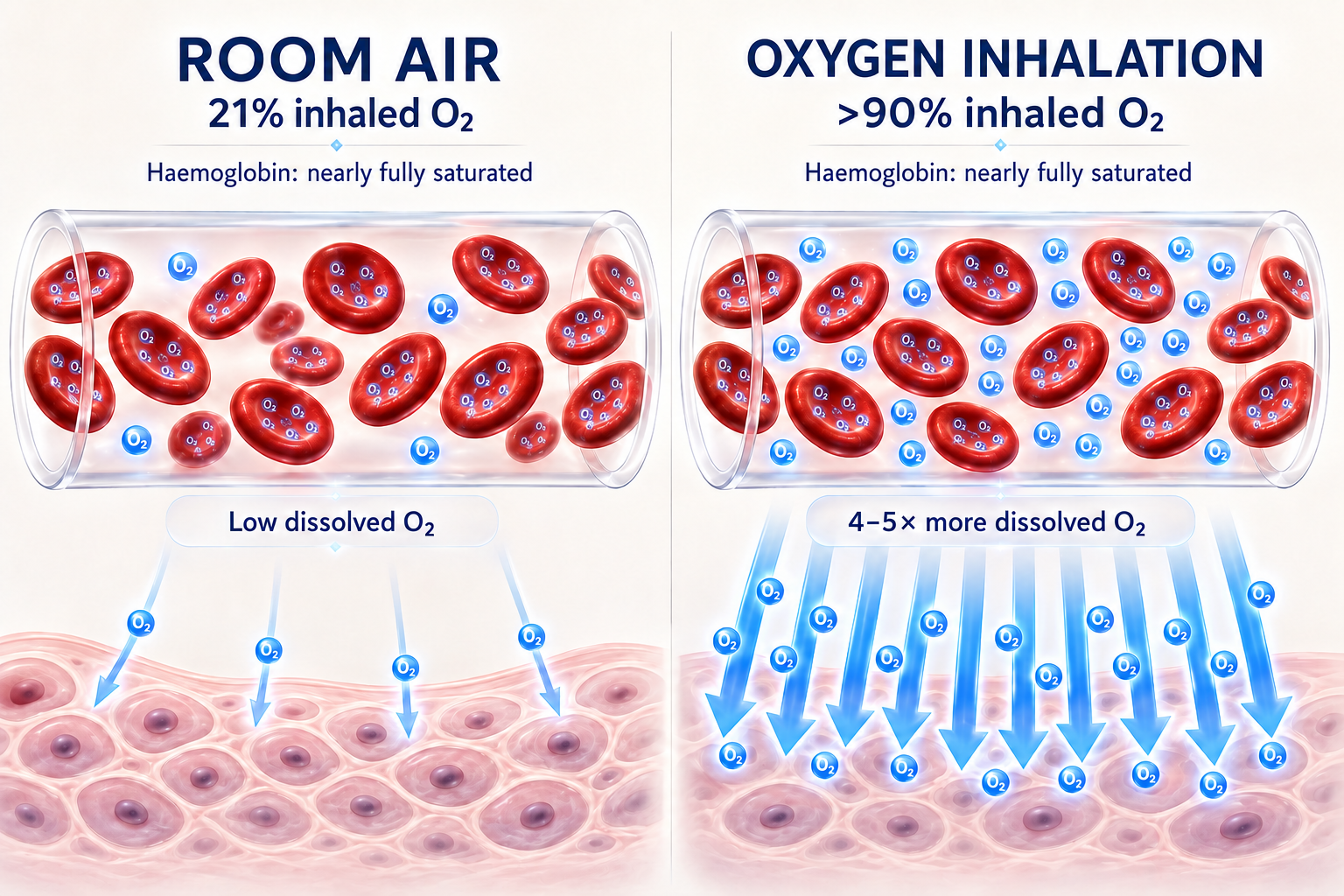
This substantial increase is most strongly felt by tissues that receive most or all of their oxygen through diffusion from the surrounding tissues, including cartilage, tendons and ligaments, as well as by injured tissues with compromised circulation. By increasing oxygen availability, tissues experiencing hypoxia and approaching structural degradation and metabolic cell death receive additional oxygen and are given the opportunity to recover metabolically. This reduces the zone of tissue damage following injury and accelerates the formation of new, healthy tissue.
Integrating oxygen with regenerative treatment
Many physical therapy modalities—including TECAR therapy, therapeutic ultrasound, cupping, massage and different thermal treatments—are based on increasing the amount of blood delivered to the tissue and, consequently, increasing oxygen delivery. Combining oxygen inhalation with physical therapy further enhances this effect and thereby improves the effectiveness of the overall treatment.
Advanced proloregenerative therapy stimulates the cellular processes required for tissue repair, including collagen synthesis, extracellular matrix formation and remodelling of damaged tissue. These processes are metabolically demanding and require continuous ATP production. Adequate oxygen availability is therefore essential to prevent oxygen delivery from becoming a limiting factor during healing. Increasing dissolved oxygen supports mitochondrial energy production, particularly in hypoxic, injured and poorly vascularised tissues, creating more favourable metabolic conditions for regeneration and helping to shorten the time required for recovery.
During oxygen inhalation, signs of metabolic fatigue, including lactate levels in the blood and muscles, are also reduced, allowing the entire body to “rest” and recover more rapidly.
During treatment, high-concentration oxygen concentrators are used, producing oxygen concentrations above 90% at flow rates of 4–5 litres per minute. This is intended to fully meet the body’s metabolic oxygen requirements throughout the therapy.